IQ Test: Logic Brain Training
- 4.6
- Rating
- 1.00M
- Installs
- Free
- Price

 Analysis by App-foxy
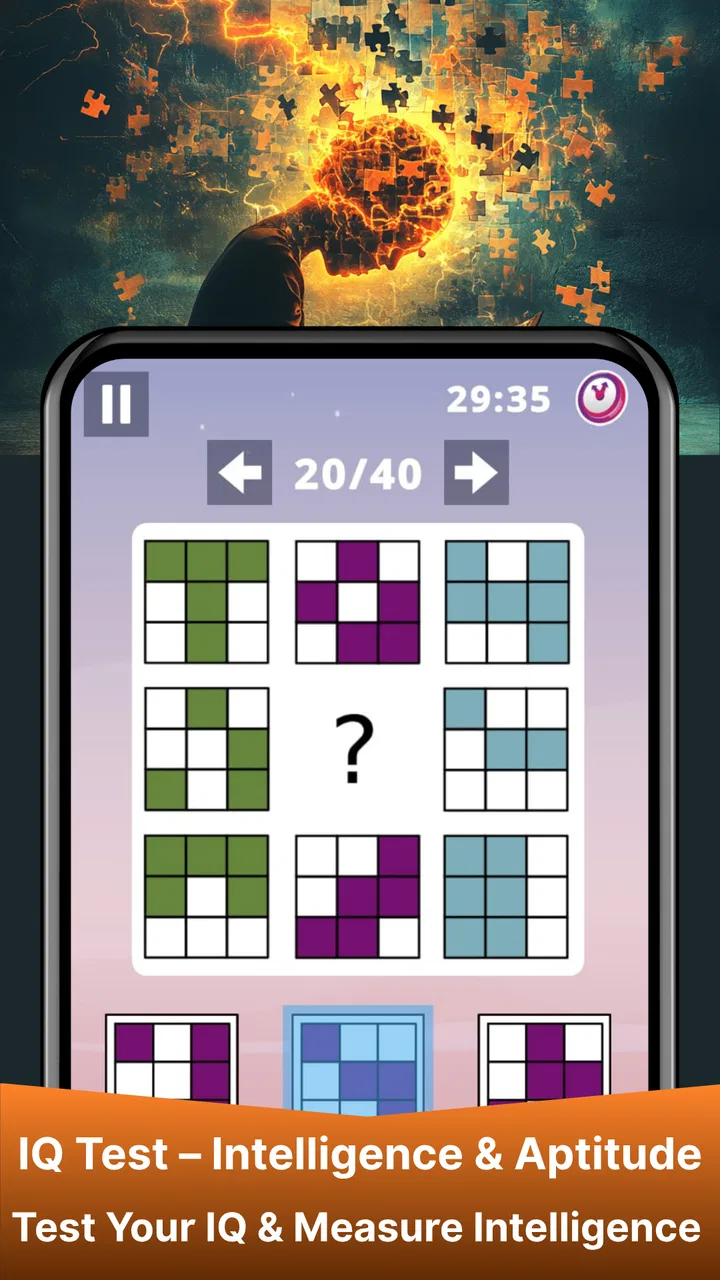
I approached IQ Test: Logic Brain Training as a quick trivia game rather than a formal intelligence assessment, and that distinction matters from the first session. It is built for short bursts of problem-solving: you read a prompt, look for a pattern or numerical relationship, choose an answer, and move on. The appeal is immediate because there is very little ceremony between opening the game and facing a puzzle.
The game comes from Trasco studio and sits in the brain-training and trivia space. It is free to install, with optional purchases priced from forty-nine cents to four dollars and forty-nine cents per item. Its age rating is Everyone, so it is suitable for a broad audience, although younger players may still need help with wording or more abstract logic.
My overall impression is positive when the goal is casual mental exercise. I would recommend it to someone who enjoys riddles, quick math questions, and pattern challenges during spare moments. I would not present it as a scientific IQ test, a structured learning course, or a replacement for a dedicated mathematics app. Its strength is the compact challenge loop, while its limitations appear when you want detailed teaching, deep progress analysis, or a carefully controlled assessment.
You May Also Like

 Blood Strike: 2.5 Anniversary
Blood Strike’s Loadouts Turn Every Drop Into a Tactical Gamble
A close look at Blood Strike’s custom loadouts: how fast access to signature weapons reshapes its battle royale rhythm, rewards preparation, and narrows the gap between fights.

 Pandora - Music & Podcasts
Pandora’s Music Is Easy to Start, but Harder to Recover
Pandora’s strength is its low-effort path from a seed to a station. Its weak spot is how much confidence it asks you to place in connection, setup, and quiet recovery.

 8 Ball Pool
 Is Built on Rivalries, Rematches, and Routine
A close look at the rivalries, rematches, shared routines, and unanswered safety questions that turn a quick pool match into a persistent mobile community.

 Samsung Music
’s Quiet Strength Is Playing What You Already Own
Its reach comes less from spectacle than from dependable access to a personal library. That simplicity is both the app’s strongest retention engine and its ceiling.

 AccuWeather: Weather Radar
AccuWeather Review: A Quick, Clear Forecast for Everyday Decisions
For everyday plans, the best forecast is the one you can understand quickly. AccuWeather makes rain timing, radar, and local conditions easy to act on, with a few trade-offs.

 Hill Climb Racing
Why Hill Climb Racing Still Turns Crashes Into One More Run
A tiny car, a bumpy hill and one more upgrade: Hill Climb Racing keeps resurfacing because its simple chaos makes every near-miss feel personal.
More From Our News Desk



Where the experience can become frustrating
I find the most frustrating moments tend to come from uncertainty about a puzzle’s wording or intended rule, not from the quick format itself. In this section, I’d focus on spotting the difference between a rushed mistake and a question that simply needs a more careful read, before moving on to the practical checks that can prevent other avoidable snags.
The first difficulty is often reading the puzzle correctly
Many brain games look simple because the screen contains only a question and a few answers. In practice, the challenge may depend on noticing one small condition, interpreting a sequence in the intended direction, or separating relevant information from decoration. I found that rushing was a bigger problem than lack of ability. A question that seemed obvious often became easier after I paused and restated it in my own words.
That is the first useful habit I would suggest: do not treat every mistake as proof that your reasoning is weak. Read the exact wording again, identify what is changing, and check whether the puzzle asks for a result, a missing item, or the rule behind a group of items. This approach is especially useful for number puzzles, where a tempting answer can be produced by several possible patterns.
Short sessions suit the design better than long study periods
The game works best when I use it for a few questions at a time. A short session during a commute, a coffee break, or while waiting for an appointment feels natural. A long session can become tiring because repeated logic problems demand concentration, and the entertainment value depends heavily on staying mentally alert.
For an everyday example, I might open it after finishing a routine task at work and play until I feel my attention slipping. If I continue while distracted, I am more likely to tap quickly, misread a condition, and blame the puzzle. Closing the game and returning later is usually more productive than trying to recover a good result through impatient guesses.
Why an answer can feel unfair even when the puzzle is solvable
Logic questions are not always satisfying simply because they have an answer. A good puzzle should make the intended rule feel clear after the solution is revealed. When several rules seem possible, the experience can feel arbitrary. That is a genuine limitation of this type of app: compact questions have limited space for explanation, so the reasoning behind an answer may not always be as transparent as a learner would want.
I recommend keeping a small mental distinction between “I made a careless mistake,” “I missed the intended pattern,” and “the question was not explained well enough.” That distinction helps you decide whether to retry, slow down, or move on. It also prevents the score from becoming a judgment about your general intelligence.
What to do when a question seems stuck
When I reach a puzzle that does not click, I use a repeatable process. First, I ignore the answer choices and describe the information shown. Next, I test the simplest relationship before inventing a complicated one. For a number sequence, I check differences, multiplication, alternation, and position. For a riddle, I look for a change in the meaning of a familiar word. Finally, I compare the candidate rule against every visible part of the question.
This workflow is more useful than repeatedly selecting answers at random. It also makes the game feel like practice rather than a series of guesses. If the app lets you continue after a wrong response, I would use that moment to identify the exact clue I missed instead of immediately tapping through. The value of the session comes from the reasoning process, not only from a perfect run.
Setup checks before blaming the game
Before treating a glitch as a fault in the game, I’d check whether the phone, display, or launch conditions could be affecting the session. A calm first pass can save time and avoid risky fixes, especially if you care about your progress; the next section looks at sensible setup checks in order.
Compatibility is straightforward, but still worth checking
The current version is 2.19 and requires Android 6.0 or later. That covers many older devices, but anyone using a particularly old phone or tablet should check the operating system before spending time troubleshooting installation. The game is available as a free title, so the first practical test is simply whether the device can install and open it normally.
If installation fails, I would begin with ordinary checks: confirm that the device has enough free storage, make sure the operating system meets the requirement, and retry through the official app store after restarting the device. These steps are deliberately basic, but they solve more setup problems than changing unrelated settings.
Give the first launch a clean start
On a phone that has many apps running, I prefer to close unnecessary background activity before opening a puzzle game. This is not because IQ Test: Logic Brain Training is unusually demanding; it is a sensible way to reduce distractions and avoid confusing a temporary device slowdown with an app problem. I also avoid starting a session while the phone is busy installing updates or restoring other content.
If the app opens but behaves strangely, I would close it completely and launch it again before changing anything more serious. A single failed load is not enough evidence that the installation is damaged. If the issue continues, restarting the device is the next reasonable step. Clearing app data or reinstalling should be treated as a later option because those actions can remove local progress or settings, depending on how the app stores them.
Purchases deserve a deliberate approach
The game is free, but optional in-app purchases range from forty-nine cents to four dollars and forty-nine cents per item. I would not buy anything simply to get past a puzzle that I have not understood. First I would reread the question, try the reasoning method above, and decide whether the purchase provides something I genuinely want rather than acting as a reaction to frustration.
This is also a good reason to set purchase controls on the device if children use it. The Everyone rating makes the game broadly accessible, but an age rating does not replace supervision around optional spending. I would let a younger player enjoy the free portion first and discuss purchases before allowing any transaction.
Use the right environment for a reasoning game
Screen glare, poor concentration, and hurried tapping can make a simple puzzle feel broken. I get better results when the phone is held steadily, the display is easy to read, and I am not trying to answer while walking or handling another task. That sounds obvious, but trivia games are unusually sensitive to small attention failures because one missed symbol or word can change the entire answer.
If text appears difficult to read, I would first adjust the device’s display settings or move to better lighting rather than assuming the game itself has a rendering fault. If only one puzzle looks unusual while the rest of the app works normally, I would treat it as a content or interpretation issue. If the entire interface is affected, restarting the app is a more sensible first response.
Recovering a session when something goes wrong
An interrupted round does not always need a drastic fix, and repeated tapping can make a temporary freeze harder to diagnose. I’d first identify whether the issue is an incorrect response, an unresponsive screen, or a session that has reset, then choose the lightest recovery step that fits.
Separate a wrong answer from a technical failure
The most important recovery step is identifying what actually failed. A wrong answer, an accidental tap, a frozen screen, and a lost session require different responses. If the game responds normally and simply marks an answer incorrect, I would continue with a slower method. If the screen stops responding, I would leave the session, close the app, and reopen it rather than repeatedly tapping.
Repeated taps can make a problem harder to understand because they may trigger unintended selections when the interface catches up. Waiting a moment, restarting cleanly, and testing one question is a better diagnostic routine. I would also avoid reinstalling immediately, especially if I care about progress and do not know whether it is stored locally.
What to do after an interruption
Phone calls, notifications, low battery, and switching between apps can interrupt any short-session game. After returning, I would check whether the current question is still visible and whether the controls respond normally. If the session has reset, I would regard that as an inconvenience rather than repeatedly trying to force the previous screen back.
For that reason, I would not begin a serious personal challenge immediately before changing locations or starting another activity. The game is better suited to disposable sessions than to a single uninterrupted test that must be preserved. If maintaining a personal record matters to you, write down your own result after a session instead of assuming every interruption will preserve it.
When reinstalling is reasonable
Reinstallation is a last-resort recovery step for persistent launch or display problems after closing the app and restarting the device. Before using it, I would consider whether the game contains progress I want to keep. A fresh installation can resolve corrupted local files, but it can also create a clean start. Because the title is free to install, the financial barrier is low, yet the possible loss of local history still makes this step worth considering carefully.
I would also make sure the device is connected reliably during the process and that the installation completes fully before judging the result. If the same issue returns immediately, the problem may involve the device environment rather than the game’s puzzle content. At that point, changing random settings is unlikely to help.
When the app is not the cause
Not every poor result is a software problem. A puzzle can feel impossible when I am tired, distracted, or trying to solve it with an assumption the question never made. The game’s compact format encourages fast answers, but speed is not always the same as skill. I would rather spend an extra minute checking a sequence than decide that the app is malfunctioning because my first pattern did not work.
There is also a difference between a game designed for mental stimulation and a formal cognitive evaluation. A score in this app should be treated as a result within its own puzzle set, not as a medical conclusion or an official measurement of intelligence. Anyone needing a reliable assessment for school, work, or health reasons should choose an appropriate professional or standardized route instead.
How it compares with ordinary alternatives
Compared with a traditional paper puzzle book, this game is more convenient because it is already on a phone and can fill very small gaps in the day. A book may be better for people who want to annotate reasoning, revisit a puzzle physically, or avoid screen time. Compared with a dedicated mathematics-learning app, this title is likely more playful and varied, but it is less suitable when you need a lesson sequence with careful explanations.
Compared with a formal IQ test, it is much more casual. That is not a weakness if your aim is entertainment and practice, but it becomes a problem if you expect a validated score. Compared with multiplayer trivia, it places more emphasis on individual reasoning than on speed against other people. I prefer it when I want quiet concentration rather than social competition.
Who will get the most from it
I think the best audience is someone who enjoys riddles, pattern recognition, and quick arithmetic but does not want to commit to a long game. It can also work for a parent and child solving questions together, provided the adult explains unfamiliar wording and keeps purchases supervised. The age rating of Everyone makes that shared use comfortable from a content standpoint.
It is less suitable for someone who needs detailed correction after every mistake, a guaranteed difficulty progression, or a dependable record for serious comparison. It is also a poor match for players who dislike ambiguity in riddles or who become discouraged when a puzzle’s intended rule is not immediately obvious. In those cases, a structured educational tool or a clearly explained puzzle book may be the better choice.
Small habits that improve the experience
- Slow down before selecting: read the complete prompt and identify exactly what the answer must represent.
- Test the simplest rule first: complicated explanations are often less useful than checking basic changes, alternation, or position.
- Use mistakes as notes: remember whether the error came from arithmetic, wording, attention, or an unsupported assumption.
- Stop before fatigue takes over: a short break protects the quality of your reasoning better than rapid guessing.
- Keep purchases intentional: enjoy the free experience first and treat optional items as a choice, not a requirement for proving yourself.
My practical verdict
After using it as a casual brain-training game, I see a clear reason it has attracted a large audience: it offers an approachable way to turn a spare minute into a small reasoning challenge. It has an average rating of 4.4 from around thirty-four thousand ratings, and the game has passed one million installs. Those figures fit my impression of a title that is easy to start and broad enough for many kinds of casual players.
Still, popularity should not change how you use it. I would open it for riddles, number puzzles, and a mental reset, not for a definitive statement about my intelligence. I would also keep expectations realistic around explanations, interruptions, and optional purchases. The experience is strongest when I treat each question as a compact exercise in careful thinking rather than a high-stakes exam.
My recommendation is simple: try it if you want a free, accessible trivia game for short logic sessions and you are comfortable solving some questions through patience rather than instant certainty. Skip it in favor of a structured learning app, paper puzzles, or a formal assessment if you need teaching depth, written working space, or scientifically meaningful results. For casual daily use, however, IQ Test: Logic Brain Training is an enjoyable tool as long as you value the process of reasoning more than the number attached to the outcome.
FAQs for IQ Test: Logic Brain Training
01What is the main purpose of IQ Test: Logic Brain Training?
IQ Test: Logic Brain Training is designed to challenge and enhance your cognitive abilities through a series of logic puzzles and brain teasers. It aims to improve problem-solving skills, critical thinking, and mental agility, making it an ideal app for individuals looking to sharpen their minds.
02Is IQ Test: Logic Brain Training suitable for all age groups?
Yes, IQ Test: Logic Brain Training is designed for a wide range of age groups. The app offers various difficulty levels, allowing both younger users and adults to enjoy and benefit from the challenges. However, it’s always recommended that parents review the content to ensure its appropriateness for younger children.
03Does IQ Test: Logic Brain Training require an internet connection to play?
No, the app can be used offline, making it convenient for users to enjoy the puzzles anywhere without needing an internet connection. However, an internet connection is required for certain features such as leaderboard updates or accessing new content updates.
04Are there any in-app purchases or ads in IQ Test: Logic Brain Training?
Yes, while IQ Test: Logic Brain Training is free to download and play, it does include optional in-app purchases that can enhance the user experience, such as unlocking additional puzzles or removing ads. Users can enjoy the core features without any purchase, but ads may be present.
05How does IQ Test: Logic Brain Training track progress and results?
The app provides detailed statistics and feedback on your performance, allowing you to track your progress over time. It offers insights into your strengths and areas for improvement, and you can compare your scores with others on global leaderboards to see how you rank.
Pros
- Engaging puzzles boost cognitive skills.
- User-friendly interface enhances experience.
- Variety of levels keeps it interesting.
- Offline mode available for on-the-go play.
- Regular updates with new challenges.
Cons
- Ads can disrupt gameplay flow.
- Limited hints in free version.
- Some puzzles feel repetitive.
- In-app purchases can be pricey.
- Requires internet for certain features.

IQ Test: Logic Brain Training
Gallery